Live Like You Were Living

skydive-woman-1437056

I have a confession to make. I am not a fan of the songs, inspirational quotes, and Facebook posts that tell us to “live like you were dying.” I get the point. Time is short. You have to make the most of every moment. You never know when your number may be called. My reaction to this: It’s a terribly nerve-wracking way to live your life. This pressure to do everything we think we might ever want to do for every moment of the day. To tell everyone exactly how much they mean to us every single time we interact with them. I think if I tried to live this way I would fall asleep each night convinced I had fallen woefully short of the demands of this “live like you were dying” philosophy. For example, here are some things I did today: I cleaned my bathroom. I wrote a few emails. I made a grocery list. I stared into space for a few minutes while trying to focus on work. I spent a few minutes trading dumb jokes and harmless gossip with my sister. I watched TV.

Not exactly skydiving and poetry.

The fact is, most of us live a life marked by the ordinary. It’s how we choose to frame that ordinary, that matters. And we don’t need a death knell to achieve it. We just need a simple reminder that God loves us. That God is good. And that God chooses us and blesses us. The process of becoming who we’re meant to be is often gradual. We are each a work in progress. We look back on the ordinary moments and realize that our life is about something or it is not yet. But there’s still time. For the vast majority of us, there’s still time to make changes.

I’m not rejecting bold action in living out our faith. There will be those times when God calls us to take risks. To abruptly change course. To follow Him in a direction we never dreamed we could go. But most days we’re just chugging along the tracks of life. Doing our best. Imagine if every time you did something, a voice shouted at you: “But you could DIE tomorrow! Is that really what you want to be doing on your last day on earth?!?” My goodness. Who could hold up under that pressure? Imagine instead, that you heard a voice whispering to you:

“You are loved. You are called to love.”

This gentle reminder would reshape the way we see the world. The way we interact with others. The way we live.

There are many ways to live life to the fullest. And it’s true that some of our loved ones have been taken from this earth far too soon, while still others face very serious medical struggles. Our heart breaks with the unfairness of it all. We may never understand the reasons for it, and we wish we could take their place. But we must remember that God has given us our time here on earth for living. It’s ok to have regrets… as long as we share those regrets with God, release them, and keep moving forward, through each ordinary moment, listening for God’s voice teaching us and reminding us that love matters most of all.

It just might be a feeling even better than skydiving.
A Sinking Heart

bleeding-hearts

There are times we move through life with our hearts on our sleeves.  Wide open to receive God’s amazing love.  Moved to listen and understand, we are part of the vast family of the children of God. We offer prayers of gratitude for belonging.  We reach out to our sisters and brothers in loving communion.

With our hearts on our sleeves… we sing, we laugh, and we love.

There are times that our hearts curl inward.  Nestled deep within our souls.  We enter into a period of searching and deep contemplation.  Our hearts are wrapped in mystery.  We long to hear God’s whisper.  We know there is something God wants to teach us and we cling to the quiet so we may uncover His truth.

With our hearts drawn in… we listen, we pray, and we learn.

And still other times our hearts just sink.  We are lost in the fragments of a broken world.  Hope eludes us and despair overwhelms us.  We cannot imagine a world in which God is present and working for good.  Our rational minds tell us that God is out there, but with plummeting hearts we cannot see Him.

With our hearts in the depths… we doubt, we cry, and we ache.

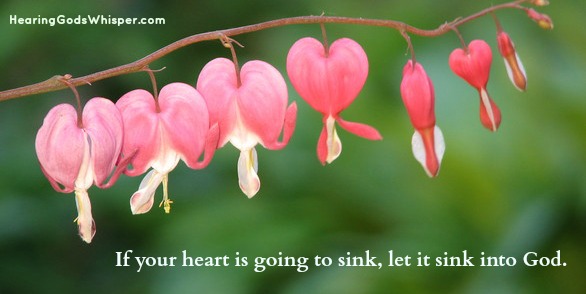
If our hearts are going to sink, let them sink into God.  Not an out-of-control free fall, but a falling in faith. This act of surrender will bring us closer to God than ever before.  We give up our pain, our flaws, and our doubts, confident that God is strong enough to bear it all.  The further we allow ourselves to fall, the higher God will lift us up.

If our hearts are going to sink… let them sink into God.

Allegory of Five Gardens (Part Four)

sunflowers-268015_960_720

Long ago, in a land far away, there lived five sisters. The Master Gardener, who loved them all very much, gave each sister a gift – a small plot of land to plant a garden. With excitement and hope, they prepared the soil and planted seeds, giving them lots of water and sunshine until they sprouted into healthy plants. As time went on, the five sisters tended to their gardens in their own different ways.

Months later, the Master Gardener invited each sister, one at a time, to come and share with him how her garden fared. The fourth sister marched right up with her head held high and a satisfied smile on her face.

“How does your garden fare, my child?”

“Oh, you have to come see it!” she exclaimed.“I threw away the seeds you gave me because I knew they wouldn’t produce the biggest, most colorful blooms. The flowers I chose are amazing! The prettiest in the village. Every day I stand outside so I can see the villagers walk by my garden and marvel at how beautiful it is.”

“My beloved daughter,” the Master Gardener replied. “While it is true I gave you the garden to do with as you pleased, it seems as if your only goal is praise and admiration. Your garden can be used for so much more. To grow food for the poor. To provide a quiet place where you might sit and pray. You have turned it into nothing more than a showpiece.”

The fourth sister was humbled by the words of the Master Gardener, and she realized he was right. It had become too important to her to have the biggest, most beautiful garden. From that day on she replaced some of the more ostentatious blooms with beans, peppers, and tomatoes, which she shared with all who were hungry. And in the early morning, when no one else was around, she spent time reflecting and praying in her garden. Over time, it came to mean so much more to her than the dazzling display she used to show off to the village.

REFLECTION

If we take an honest look at ourselves, I’m sure there are times we’ve been guilty of behaving like this fourth sister. Putting on a show of our faith. Praying to impress. We may not even realize we’re doing it. It’s perfectly human to want people to think well of us, but it shouldn’t take the place of an honest and intimate relationship with our loving Father.

In Matthew’s gospel, Jesus says: “And when you pray, do not be like the hypocrites, for they love to pray standing in the synagogues and on the street corners to be seen by others. Truly I tell you, they have received their reward in full. But when you pray, go into your room, close the door and pray to your Father, who is unseen. Then your Father, who sees what is done in secret, will reward you.” (Matthew 6:5-6).

A common misinterpretation of this Gospel passage is that Jesus is condemning public prayer. But we know this is not the case. When Jesus takes the seven loaves and fishes, he breaks the bread and very publicly gives thanks to God before sharing the food. This is what we do every Sunday when we gather to worship. Praying in community is not what Jesus calls into question here. Instead, Jesus challenges us to examine our motives.

Ask yourself these questions: Am I praying to put on a show, to garner praise from others, to compete? Is it more important for me to be seen as pious and spiritual than to really be present to God while I am praying? Am I making my prayer life all about me instead of all about God?

Years ago I belonged to a prayer group that gathered together once a week to pray for our children. I often received praise for the prayers I offered, compliments on a particular turn of phrase or the words I chose. I liked the feeling so much that the weekly sessions became like a performance for me. I was determined to impress each week with the prayers I offered. In my efforts to earn praise and compliments, I began to lose sight of why I was praying in the first place. It was a humbling lesson to learn.

Prayer life isn’t about appearance. It should go much deeper than that. Prayer is conversation with God—the words we speak to our loving Father directly from our heart. We don’t need an audience or a stamp of approval from our peers to achieve this kind of close relationship with God. Let your garden of faith become a time of quiet stillness. A time of praying and listening.

A Look Beneath the Surface

flowering tree

The window in my office looks out over a pretty little tree that blooms with beautiful pink flowers in the spring time.  It brightens my day all season to look out on this splash of color.  Last week I happened to look up from my computer to the shocking sight of this tree slowly and quietly falling to the ground.  Huh?!?  What happened?!?  It wasn’t stormy or even windy out.  What knocked this tree over?

I went out for a closer look and realized that half of the tree was badly diseased.  Some kind of white fungus or mold had killed off the leaves and weakened the branches.  I was heartbroken to realize that the tree had been slowly dying and I never even noticed.  I walk by that tree every single day on my way into work, but only appreciated it for what it could give me, a pretty view during the spring season.

How often do we do that with the people in our lives—look only at the surface?  The brave face they are presenting to the world.  But if we looked a little deeper, we would see sadness, pain, or worry.  Obvious sorrow is easy to see and respond to.  But quiet suffering takes place under the surface.  The only way to discover it is by taking a closer look.  Paying attention to those around us.  Shifting the focus from our own lives for a little while to listen and be present to others.

Jesus was good at noticing those who were lost, dejected, and silently suffering.

In Luke’s Gospel we learn of a woman who had been bleeding for twelve years and could not be healed.  When Jesus passed by, she came up behind him and touched the edge of his cloak.  Jesus asked his disciples who had touched him and they shrugged it off, assuming it was just the crowd pressing in on him.  Not satisfied with that explanation, Jesus took the time for a closer look.  As he searched the crowd, the woman came up to him and fell at his feet.  By her faith she was immediately healed. (Luke 8:43-48) The Gospels are full of stories like this. Jesus was all about connection and healing.  He wanted to reach everyone.

I’ll never know if there’s anything that might have saved that tree.  But if I had been paying better attention, I could have called the groundskeeper.  He would have diagnosed the tree and possibly even healed it.  It was a sad lesson to learn and one that has inspired me to be more present to those around me.  To focus less on me and more on others.  A reminder that everyone I meet is a child of God.  Everyone is worth a closer look.  I pray to follow the example of Jesus as I strive to look beneath the surface.  To listen and really hear.  And to serve.

Allegory of Five Gardens (Part Three)

weeds

Long ago, in a land far away, there lived five sisters. The Master Gardener, who provided all that they needed, gave each sister a gift – a small plot of land to plant a garden. With excitement and hope, they prepared the soil and planted seeds, giving them lots of water and sunshine until they sprouted into healthy plants. As time went on, the five sisters tended to their gardens in their own different ways.

Months later, the Master Gardener invited each sister, one at a time, to come and share with him how her garden fared. The third sister approached with shrugged shoulders and confusion in her eyes.

“How does your garden fare, my child?”

“Not well, and I don’t understand why! I sit in my garden every day and pray. For hours I offer prayers of thanksgiving and praise. Yet my garden is a mess! Weeds are sprouting up everywhere, crowding the healthy plants and robbing them of sunlight and nutrients.”

“My beloved daughter,” the Master Gardener replied. “Your prayers are always welcome, but I gave you this garden as a gift, in the hopes that you would care for it through your actions, not just your prayers. The garden needs you if it’s going to thrive. You must show your love by tending it.”

Understanding dawned on the third sister’s face as she realized what she had failed to do. Running home, she spent an entire day cleaning up her garden. Pulling weeds, pruning, watering, and feeding her plants. As a result, it flourished. She had healthy, nutritious vegetables to feed the poor and hungry in the village. She promised never again to forget to do her part.

REFLECTION:

Jesus came to preach a radical message of love and social justice. Our actions matter just as much as our words.   Piety and prayer – while extremely important – is not enough. Jesus challenges us to feed the hungry, give drink to the thirsty, welcome the stranger, clothe the naked, care for the sick, and visit those in prison. He reminds us: “whatever you did for one of the least of these brothers and sisters of mine, you did for me.” (Matthew 25:40)

I’ve written before about introverts like myself who are very good at finding time for quiet prayer, but more challenged by the idea of living our faith through action – or Inter-action in this case. God’s gift of grace is ours for the taking, but we must be active participants in this gift. We do so by living out Jesus’ message of love. By becoming the face and hands of Jesus for all those we encounter. In the parable of the Good Samaritan, it is the Samaritan – not known for being pious or obedient to the law – who wins the praise of Jesus through his act of compassion. So many of Jesus’ parables emphasize the importance of putting our faith into action through our deeds.

A faith lived in words only will resemble the neglected garden of the third sister. Take some time this week to look for ways in which you might reach out to others to spread Jesus’ message of love. Come up with an “action plan” for the rest of month or the next season. You will be rewarded with a garden filled with abundant love and grace as you begin to fulfill God’s purpose and plan for your life.

Allegory of Five Gardens (Part Two)

crowded garden

Long ago, in a land far away, there lived five sisters. The Master Gardener, who loved them as his own, gave each sister a gift – a small plot of land to plant a garden. With excitement and hope, they prepared the soil and planted seeds, giving them lots of water and sunshine until they sprouted into healthy plants. As time went on, the five sisters tended to their gardens in their own different ways.

Months later, the Master Gardener invited each sister, one at a time, to come and share with him how her garden fared. The second sister approached with dragging steps and slumped shoulders. Her cheeks were reddened from hours in the sun, and her tired eyes revealed dark smudges underneath.

“How does your garden fare, my child?”

“Too well, I’m afraid to say. I wanted to plant as many things as I could, to thank you and praise you for this wonderful gift. So I have perennials and annuals, creeping plants and climbing plants, vegetables and fruits. The garden is truly bursting with life.”

“Then why do you look so unhappy?” the Master Gardener asked with kind but questioning eyes.

“Now it keeps me so busy I’m exhausted all the time. There’s so much work involved. Weeding, pruning, watering. It never ends. It’s gotten to the point where I don’t even enjoy working in my garden anymore.”

“My dear child,” the Master Gardener replied. “I gave you this gift so you could find joy in your work. An overcrowded garden will not thrive and it will only leave you feeling tired and cross. You need balance and simplicity.

The Master Gardener helped her cut out sections of her garden (to pass along to other members of the village) and install a bench, where she could sit and rest in the shade and enjoy the beautiful bounty of her smaller and simpler garden.

A sigh of relief escaped her lips as the second sister delighted in the extra time she had to spend in quiet solitude. She promised never again to take on so much work that she forgot the reason she planted in the first place.

REFLECTION:

Does your faith life resemble the over crowded garden of the second sister? You’re involved in everything. You’re part of every church committee, prayer group, ministry, and Bible study. You can’t say no to anything. Like the sister Martha from Luke’s gospel, you’re overwhelmed with all the work you have to do.

This is a very common situation for many people who are actively involved in ministry and volunteer work. It’s called “church burnout” and we’ve all experienced it from time to time. Our busy schedule of church commitments begins to wear us down. It becomes a chore and even builds resentment. “Why do I have to do everything?!?”

Serving God through church ministries shouldn’t come at the expense of spending time with God.

The church work you do shouldn’t become a block to deepening your relationship with God.

Some points to consider:

Examine your motives. Why do you feel compelled to do so much? Is it an attempt to prove yourself worthy to God? A desire to impress others in the church? An inability to say “no”? There’s no doubt that God wants us to serve others. We see that in the example of his son, Jesus Christ. But we also see moments when Jesus left the crowds to go off by himself, taking time for quiet prayer and solitude. Look for this same kind of balance in your own faith life.

Set realistic boundaries. Once you become identified as the “go to” volunteer for getting things done, you’ll find you get called on for lots more. Be prepared for this and learn to say no if the work is getting to be too much.

Take a break.   “Come to me all you who are weary and burdened, and I will give you rest.” (Matthew 11:28) God’s grace is not dependent on a numbered list of good deeds we’ve accomplished. You’ll be no less deserving of that grace if you scale back a bit. Remember, God want us to live healthy, balanced lives. The garden of your faith life should reflect that.

So if you’re feeling like this second sister, take some time to sit in your garden and pray. Block out all distractions of fundraisers, committee meetings, and potlucks. Come to God in the silence and rest in His loving embrace. You’ll be glad you did and your faith garden will find new life after a period of rest.

*Read Part One of Allegory of Five Gardens here.

Be Now My Vision: Seeing With Eyes of Faith

blurred Easter cross

This morning while driving to work, I put on my sunglasses and quickly realized that they were smudged, making everything a bit blurry and unfocused.  I could see well enough to drive safely, but I couldn’t wait for the next red light so I could clean them.  Wouldn’t you know… for the first time in the history of my commute, I hit nothing but green lights all the way!  So I was stuck with a smudgy view for this ride.

It took an embarrassingly long time for me to realize the solution was simple – just take off my sunglasses.  Ah!  My vision cleared and everything looked crisp and bright and focused. The experience got me thinking about “vision” and how we see the world.  It reminded me of a gospel story we hear during the season of Lent.

Meet Bartimaeus, a blind beggar who lived on the streets of Jericho.  Life was difficult for Bartimaeus, but his blindness and his life on the streets made him adept at hearing and listening.  He had heard stories of a man they called Jesus who could heal people with the touch of his hand.  A man who told stories about lost sheep, a mustard seed, and a new kind of kingdom where all were welcome at God’s table.  Bartimaeus knew if he could just meet this amazing man, maybe touch his cloak, perhaps he, too, could be healed.

It was this rock-solid faith of a blind beggar that drew the attention of Jesus on the road to Jericho.  Instructing his disciples to bring the man to him, he asked Bartimaeus what it was that he wanted.

“Son of David, I want to see.”

Seven simple words and his life was changed forever.

“Go,” said Jesus, “your faith has healed you.”

Easter cross

Though he was blind, Bartimaeus did not lack vision.  He was able to “see” with eyes of faith.  He could see… and believe… that Jesus came to bring us new life and a new way of living. He believed that Jesus was here to show us the way if we only seek him.

On Palm Sunday our church sang a beautiful song called “Christ in Me Arise.”  The first verse contained the following lyrics:

Be now my vision; open these eyes,
Showing me all that I must see.

During this holiest of weeks, let us take an honest look at how we view the world.  Are there times that we see through the smudged glasses of fear, jealousy, anger, or indifference?  Are we unable to see what’s really going on because of entrenched ways of thinking?  Does ignorance make us blind to the suffering of others or the true feelings of others? When we fail to see with eyes of faith, our world is smudged, like my cloudy commute to work.  We can’t see what’s really important.

We’re aren’t blocking out the “sun” with these glasses.  We’re blocking out the Son.

Let us pray that Jesus, the healer, will open our eyes and help us let go of whatever it is that prevents us from seeing things clearly.

Be now my vision, O Lord of my heart!

What Makes Your Life Full?

night sky remember quote

The essence of wisdom is remembering what we already know.
So what is it that we already know?

We know that God is always with us.
But do we REMEMBER to feel His loving presence during difficult times?
We know how important it is to spend quiet time in prayer.
Do we REMEMBER to break from our hectic schedules to pray or sit in the stillness?
We know that God called us from the womb, a precious creation in His own image.
Do we REMEMBER to value ourselves as gift?
We know that Jesus died for us.
Do we REMEMBER to reflect on the enormity of that sacrifice
and what it means for us?

Life is FULL of distractions, interruptions, interferences, disruptions.
We say we’re busy, chaotic, hectic, frenzied.
Life if FULL of the unforeseen, the unpredictable, the unexpected, the unplanned.
We get pulled away, wrapped up, preoccupied, sidetracked.

REMEMBER how much God loves you.
REMEMBER that God is always waiting for you.
REMEMBER all of this…

And your life will be FULL indeed!

An Introvert’s Guide to Advent

winter branches

My sister and I have a long-standing joke that she’s my “Wake Wingman.”  I’m an introvert and so immersing myself in large crowds has never been my thing. Small talk can be draining for me. I also internalize emotions and wakes are brimming with feelings.  My sister, on the other hand, is a gregarious, extroverted, social being.  She always knows what to say, and large crowds of overflowing emotion bring out the best in her.  So whenever possible, I tag along behind her at wakes.  I mean I literally stand behind her the whole time, glued to her side.  As we work our way through the line, she says something to the neighbor or co-worker and I nod my head in agreement, offering a sympathetic look or a gentle smile if appropriate.  We’ve been doing this for years and it works for us.

My expression of sorrow is no less sincere; it just has a different delivery method.

It got me thinking about the challenge for introverts to live out the message of Jesus.  Jesus was all about relationships.  Love your neighbor, help the poor, gather in communities to pray.  For some, this comes as naturally as breathing.  Serving a meal to a hundred patrons of a soup kitchen would leave an extrovert feeling energized and ready to take on the world.  For me, I would want to crawl under the covers and turn out the lights.  Not because I don’t love my neighbor.  Or I don’t care about helping those in need.  It’s just harder for me.  Being an introvert means that you’re more energized by time spent alone rather than with people.  Social crowds can quickly sap the introvert of energy.  There’s a tendency to seek out quieter, less publicly stimulating environments.

But that doesn’t mean you can’t put your faith into action, particularly at times of the year when we’re reminded of the importance of doing so.  And so I offer you:

AN INTROVERT’S GUIDE TO ADVENT

WRITE.  Introverts need time to think about what they want to say and how they want to say it.  Writing is an ideal outlet for this kind of communication.  Use correspondence to live out Jesus’ Great Commandment.  For the remainder of Advent, send one email or note each day to someone you care about or admire.  Tell them how you feel.  Plan for bigger goals in the New Year.  Start a blog!  Join an online Bible study.

LISTEN.  Introverts are gifted at listening and their calm, gentle demeanor is the perfect balm for someone in distress.  The holiday season can tap into loneliness and sadness for a lot of people. Look for opportunities to lend a listening ear to someone who needs it.  A meaningful one-on-one connection allows you to be Jesus for that person, and to see Jesus in them.

PRAY.  Quiet prayer comes naturally to introverts and what better time of year to embrace the silence and stillness than Advent.  Seek out a moments of quiet solitude as often as you can. “For God alone, my soul waits in silence.” (Psalm 62:1) Try new forms of silent prayer like meditation or adoration of the Blessed Sacrament.  Use this holy season to deepen your relationship with God.

BE CREATIVE.  Many churches and faith communities offer opportunities for community service at this time of year.  If helping others by being in the thick of the action doesn’t work for you, find ways to help behind the scenes.  Instead of mingling at a fundraiser, volunteer to help design the flyer, or stuff envelopes.  Your contribution is no less important because you weren’t “in the spotlight.”

STRETCH.  Don’t let being an introvert become an excuse. It’s a huge temptation for introverts to hide away rather than engage with the world. Look for ways that God is gently challenging you to stretch out in faith.

Whether you’re an introvert, an extrovert, or somewhere in between—my prayer for you this Advent season is that you will seek ways to grow in your relationship with our loving God, as we await the coming of our Savior.  Come, Lord Jesus, come!

God Smooths Out Our Jagged Edges

smooth stone

Have you ever taken a close look at a river rock?  These flat rocks, found in riverbeds and on beaches, are unique in size, shape, and color but with one similarity.  They are smooth.  No jagged edges, sharp corners, or pointy bumps.

What makes these rocks so smooth?

Water flowing in a river is constantly moving.  A powerful force that carries along dirt, sediment, and smaller stones in its path.  These rough items bump up against the river rocks, acting like sandpaper.  They break off the pointy bumps, round out the sharp corners, and smooth the jagged edges.  This is a natural process, called weathering or erosion, and occurs over a long period of time.  The end result is a smooth and shiny stone, beautiful in its purity.

Can we compare this process to our own lives?

At times… are you the jagged rock?  Uneven and rough.  Covered in sharp edges that cause pain in your own life or the lives of those around you.  Each rough spot representing a heavy burden, a sharp tongue, a harsh response, a jealous thought, or a past pain.  Without realizing it, you become something that causes others to wince upon contact.  Something that cannot hold or be held.

And how often do you feel like that rock being tumbled around in a swirling river?  Bumped and tossed.  Crashing into those around you—or being crashed—with a force you feel you can’t control.  It can make you feel helpless… or even hopeless.  There’s no gaining your footing in such a riotous atmosphere.

I encourage you to look at this in another way.  The pain is real, but the process is powerful and profound.  The driving force is the water and it’s no random occurrence.  The water represents the Divine Source that is constantly washing over your jagged soul, breaking off those burdens and pains.  Carrying them away.  Smoothing them out.

We believe in a loving God that shapes us in this way.  We are first introduced to this Living Water at our Baptism.  An outward sign of an inward grace.  A never ending flow of mercy, love, compassion, and forgiveness. The process isn’t always easy.  Weathering can be painful!  Life tosses us around whether we like it or not.  God uses these “tossed” experiences to shape us.  God uses our trials to smooth us out until we are transformed.  “See, I am doing a new thing!”  (Isaiah 43:19)

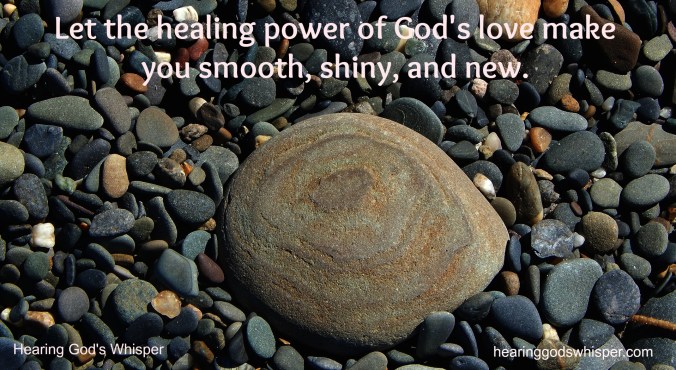
Does this sound good to you?  Are you asking: How can I get in on this deal?  It’s simple.  All you have to do is let it happen.  God is always working in you, whether you realize it or not.  Let the healing water of God’s love rush past you and surround you, making you smooth, shiny, and new.  If you’d like to become more tuned in to the ways in which God is working in you… try prayer, Reconciliation, meditation, or reading and reflecting on the Word of God.  You’ll find yourself gaining in awareness of God’s constant and overflowing presence in your life.

Take a look at the stone in the picture above. As you gaze at the surface, use God’s eyes to search for your shining reflection. What do you see?  Do you see the grace-filled moments of your life reflected back at you?  Can you see the unfolding of your purpose?  Can you see God’s promise and His deep love for you?

May God bless our journey and continue to polish us into shining reflections of His love.